
In this article, I will be writing about Chesta Balas which is part of the topic of Shadbhala. Shadbhala represents 6 fold strengths of a graha. The shadbhala is divided into 6 parts which is known as Stana Bala, Dig Bala, Kala Bala, Drik Bala, Naisargika bala, Chestabala.
Chesta Bala actually refers to a concept known as Vakra/Retrogression. Some refer to Chesta Bala as the arc of retrogression. Except for the Sun & Moon, all other grahas get into a state of Retrogression/Vakra when their Longitudinal distance from the Sun exceeds a particular limit. Chesta Bala refers to strength/potency of a planet on the account of arc of retrogression.
In simple terms, its the planet’s tendency to retrograde. In Astronomy, when the outer grahas move to the opposite side of the Sun (Opposition) they tend to move in a apparent retrograde pattern when observed from Planet Earth. This is why, Chesta Bala calculations reveal that the Highest Chesta Bala strength occurs when Outer Grahas are placed at exact 180 deg opposite to Sun. Before we get into the calculations, lets first analyze the important concepts stated by Parasharar & in Astronomy.
In BPHS Slokas 24-25 under motional strength, he mentions that to calculate the Motional Strengths for grahas, add the true longitude and Mean longitude of a Graha. Upon addition, take their average by dividing the value by 2. Subsequently, subtract this sum from the Seeghrochcha (Apogee point). If this value is less than 180, then divide by 3. If more than 180, Subtract it from 360 and then divide by 3. I will be explaining this further by the example provided by BV Raman sir in his book Graha & Bhava Balas. Before moving to this, lets first analyse some important concepts in Astronomy.
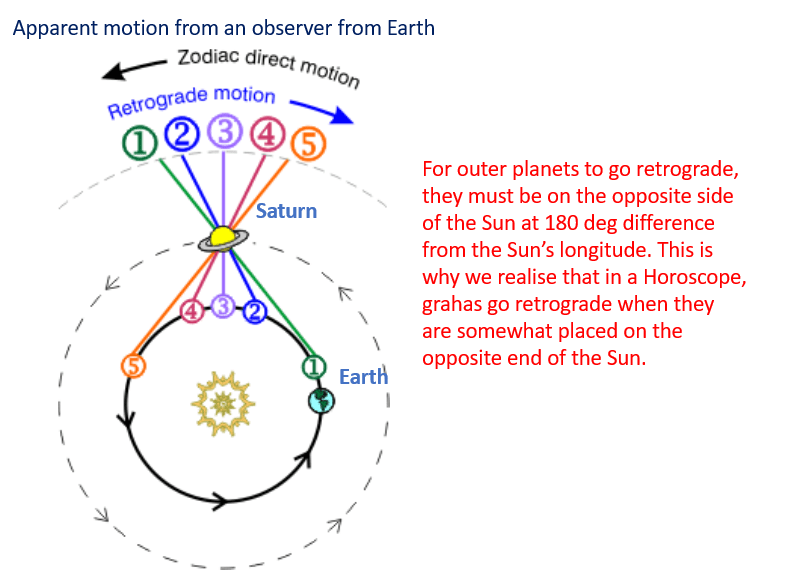
Based on above image, it is evident that for outer grahas to move retrograde, they must be at Opposition. They totally do not go into retrogression when they are on the same end as the Sun (ie. Superior Conjunction).
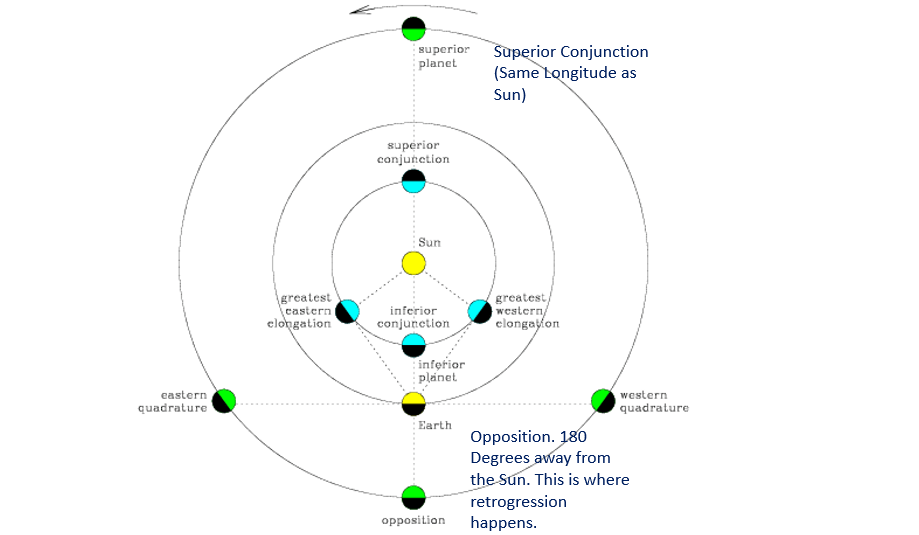
As planets move from the position of Superior conjunction towards Opposition, their likelihood of Retrogression increases (Arc of Retrogression increases/Chesta Bala increases). At opposition, maximum Arc of retrogression happens which equates to Maximum Chesta Bala of 60 Shatiyamsas/Virupas.
Now lets move to the calculation part.
Formula to find Chesta Bala:
Chesta Kendra = Graha Seeghrochcha – [(Mean longitude + True Longitude) ÷ 2] If Chesta Kendra < 180 , divide by 3 to find Reduced Chesta Kendra. If Chesta Kendra > 180, Subtract Chesta Kendra from 360 to find reduced chesta kendra. Divide by 3 to find Chesta Bala.
Therefore, maximum value of chesta bala will be 60 Virupas/Shastiyamsas.
Example from BV Raman Book:
Native born on 16th Oct 1918 at 2.06pm. To find Sun’s Mean Longitude.
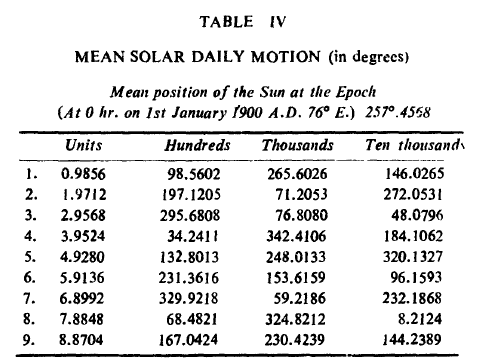
Find number of days elapsed from 1900 Jan 1st (Year 1900 is provided as the Epoch date and a table for it has been provided pg 112).
1918 – 1900 = 18years = 6570 days + 4 days (Leap Year has 1 additional day each. Leap years were 1904, 1908, 1912, 1916)
Number of days from 1 Jan to 16 Oct = 273 days + 15 = 288 days (Refer to below table)
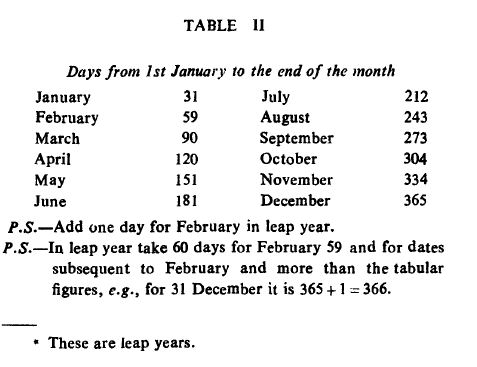
Total = 6570 + 4+ 273 + 15 = 6862 days
Native was born at 2.06 pm (Local Mean Time) and this needs to be converted to Ujjain Mean time as all mean position of planets are calculated from Ujjain 76 deg East Longitude. Based on this, the Ujjain mean time will be 2.00 pm.
Therefore; 2 pm translates to 1400 hrs = 14/24 = 0.58 days.
Total days = 6862.58 days. Lets look at how we can use the table on page 112 to find the mean position of the Sun.
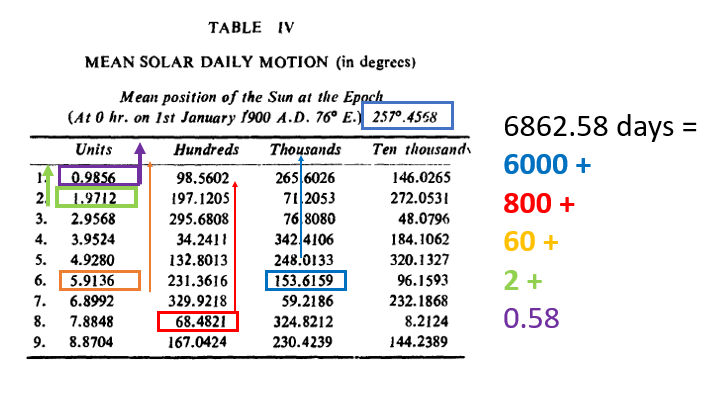
Mean longitude position of Sun =
6000 –> 153.6159
800 –> 68.4821
60 –> 5.9136 X 10 = 59.136
2 –> 1.9712
0.58 –> 0.9856 X (0.58) = 0.5656 (This estimation is slightly off. But this is what the book has provided. For education purpose, lets stick to this value)
Total = 283.7708.
We need to add 257.4568 as on the epoch day 1900 Jan 1, Sun was at 257.4568 deg.
Total = 541.2276 deg = 181.2276 deg.
This will be the mean longitude of Sun Graha.
In the same way calculate the mean longitude of each graha based on the respective tables provided in the book for each graha.
Note: The Mean longitude of the Sun will become the Seegrochcha (Apogee point) of all outer grahas based on the above mentioned reasons. Basically at Apogee, grahas are placed farthest away from Earth.

Example: Mean Longitude of Kuja = 266.34
Actual/True longitude of Kuja = 229.50
(Note: One will realize that the actual longitude and mean longitude of grahas will somewhat be similar values)
Average of mean & True longitude = 227.92
Seegrochcha – Average = 181.23 – 247.92 = – 66.69 = 293.31
Since value > 180 ; Subtract from 360 –> 360 – 293.31 = 66.69 deg.
Chesta Bala = 66.69/3 = 22.23 (Arc of retrogression)
Note: In BPHS Parashar has provided a different concept for Chesta Bala which is actually mutually exclusive from the above method.
Under the topic of Chesta Bala in BPHS, Parashar speaks about 8 kind of motions attributed to planets under sloka 21-23 (Planetary Motions). They are summarised in the table Below.
| Planetary Motion | Name | Strength (Virupas/Shastiyamsas) |
| Retrogression | Vakra | 60 |
| Entering previous Sign in retrograde Motion | Anuvakra | 30 |
| Devoid of Motion/Stationary | Vikala | 15 |
| Slower Motion than Usual | Manda | 30 |
| Slower than Manda | Mandatara | 15 |
| Somewhat increasing in Motion against Manda | Sama | 7.5 |
| Faster than Sama | Chara | 45 |
| Entering next sign in accelerated motion | Atichara | 30 |
 Dinesh Cheram Vedic Astrology Services